Introduction
The dining table is the most misunderstood piece of furniture in a UAE villa.
Most people choose it last — after the sofa, after the majlis, after the bedrooms. They walk into a showroom with leftover budget and whatever space remains in the dining room, and they buy the first table that fits. Then they live with a table that is too small for the room, too large for the actual number of people who eat there, and made from a material that cannot survive the demands of UAE family hosting.
The dining table deserves better thinking than that. It is the piece your family gathers around every day and the piece your guests remember. It is also one of the most technically demanding commissions in furniture manufacturing — the material decisions, the sizing, the base configuration, and the finish all interact in ways that are not obvious until you are already living with the consequences.
This guide covers every decision that determines whether your dining table succeeds in a UAE villa — the material, the size, the shape, the base, and the finish — with the specific UAE context that global furniture guides never address.
The Most Googled Questions About Dining Tables in the UAE — Answered
"What size dining table for my villa dining room?" Leave 90–100 cm of clearance on every side of the table between the table edge and the wall or nearest furniture. That is the minimum for comfortable chair pull-out and circulation. Measure your available floor space, subtract 180–200 cm for the clearance on both sides of the longest dimension, and that is your maximum table length. Most people buying a 10-12 seater for a room that only comfortably holds an 8-seater is the single most common UAE dining room mistake.
"Marble or wood dining table for UAE villa?" Both are excellent — but for different reasons and with different maintenance requirements. Marble is visually unmatched and feels genuinely luxurious underhand. But untreated or poorly sealed marble will stain from olive oil, lemon juice, and acidic food within months of use. Engineered stone (Quartz) gives you the stone look with dramatically better durability. Solid wood is the most forgiving long-term — scratches can be sanded and repolished at very low cost, making it look like new. Both have a place; the decision depends on how the table will be used.
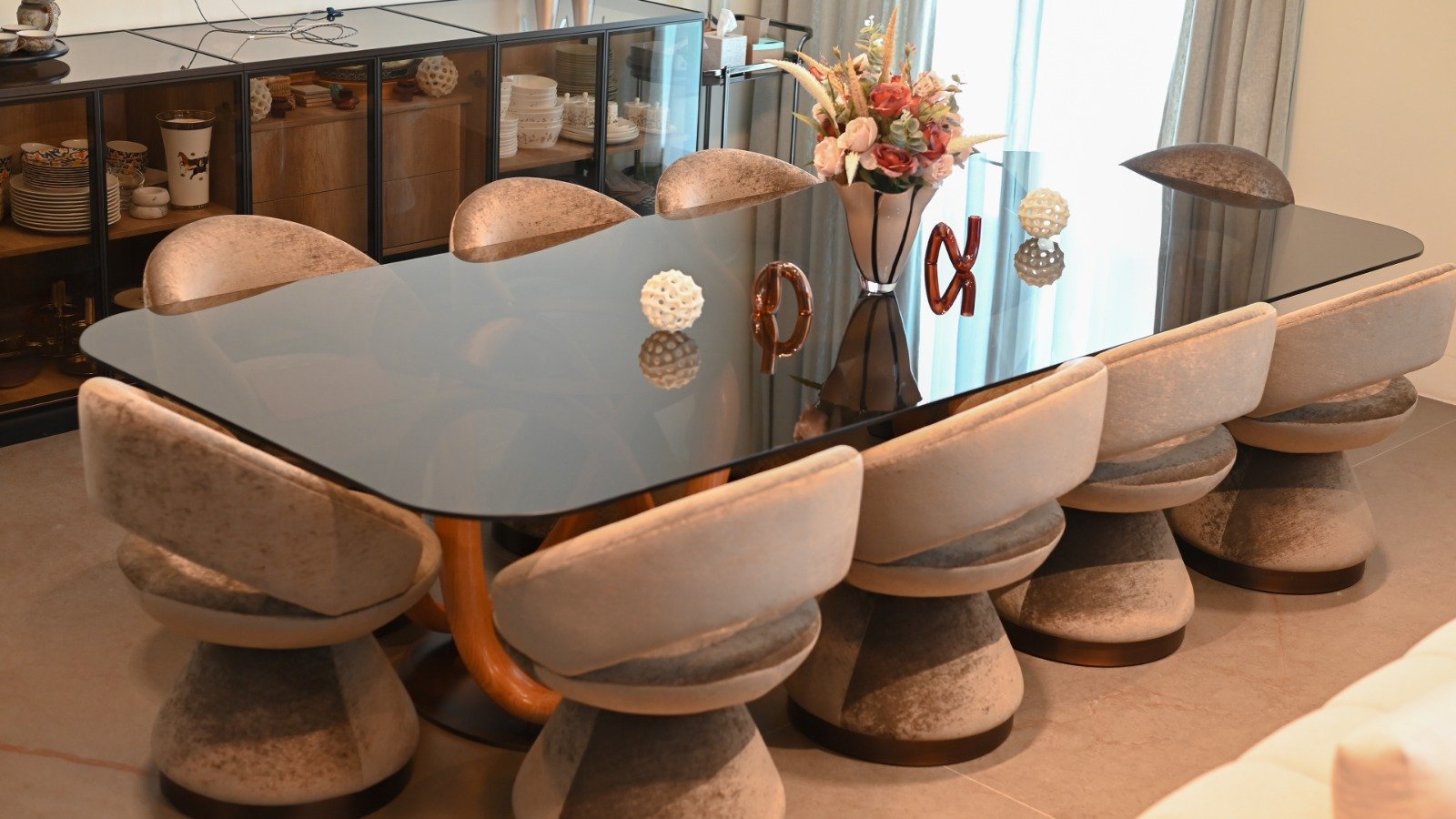
"How thick should a glass dining table be?" A minimum of 20mm tempered glass. This is not negotiable for a dining table in a UAE villa. Anything below 20mm flexes under load, is at higher risk of stress fracture, and does not provide the visual weight that reads as luxury. Fully tempered — not heat-strengthened, not laminated without tempering. Ask for the tempering certificate before accepting delivery.
"How many chairs fit around my dining table?" Allow a minimum of 60–65 cm per person along the table edge. This is the seated elbow space that allows comfortable dining without people bumping shoulders. A 240 cm table seats 8 comfortably. A 300 cm table seats 10–12 comfortably. Do not try to seat 12 around a 240 cm table — the experience will be uncomfortable regardless of how beautiful the table is.
"Is a custom dining table worth it in UAE?" Yes — particularly for rooms over 40 square metres where standard showroom dimensions will not fit the space correctly. A custom table built to your exact room dimensions, seating count, and material selection performs fundamentally differently from a showroom import sized for a European apartment.
Step 1 — Size the Table to the Room, Not the Other Way Around
This is the most important step and the most frequently skipped.
The room determines the table. The table does not determine the room.
The clearance rule. Leave a minimum of 90 cm — ideally 100 cm — between the table edge and every wall, sideboard, or fixed element on all sides. This is the space needed for a chair to be pulled out, a person to sit down, and another person to walk behind them without squeezing. In UAE villas where the host is moving back and forth to a serving station or buffet, 100 cm is the practical minimum.
The room sizing calculation. Measure your dining room length and width. For the length: subtract 200 cm (100 cm clearance on each end) to get your maximum table length. For the width: subtract 200 cm to get your maximum table width. If your dining room is 6 metres long and 4 metres wide, your maximum table is 400 cm long and 200 cm wide — which is a very large table. Most UAE villa dining rooms comfortably accommodate tables in the 220–320 cm range.
The seating count reality check. Every client wants to seat as many people as possible. The reality: a dining room that seats 12 comfortably is better than one that technically seats 16 but makes everyone uncomfortable. The rule is 60–65 cm per person minimum. Calculate your seating count from that number, not from the ambition to host the largest possible gathering.
Proportionality is everything. A dining table that is correctly proportioned to the room reads as intentional and designed. A table that is too small for the room looks like it was purchased for a different house. A table that is too large crowds the space and makes circulation difficult. The most expensive table in the wrong size will always look wrong.
Round vs rectangular vs oval — which shape for your room?
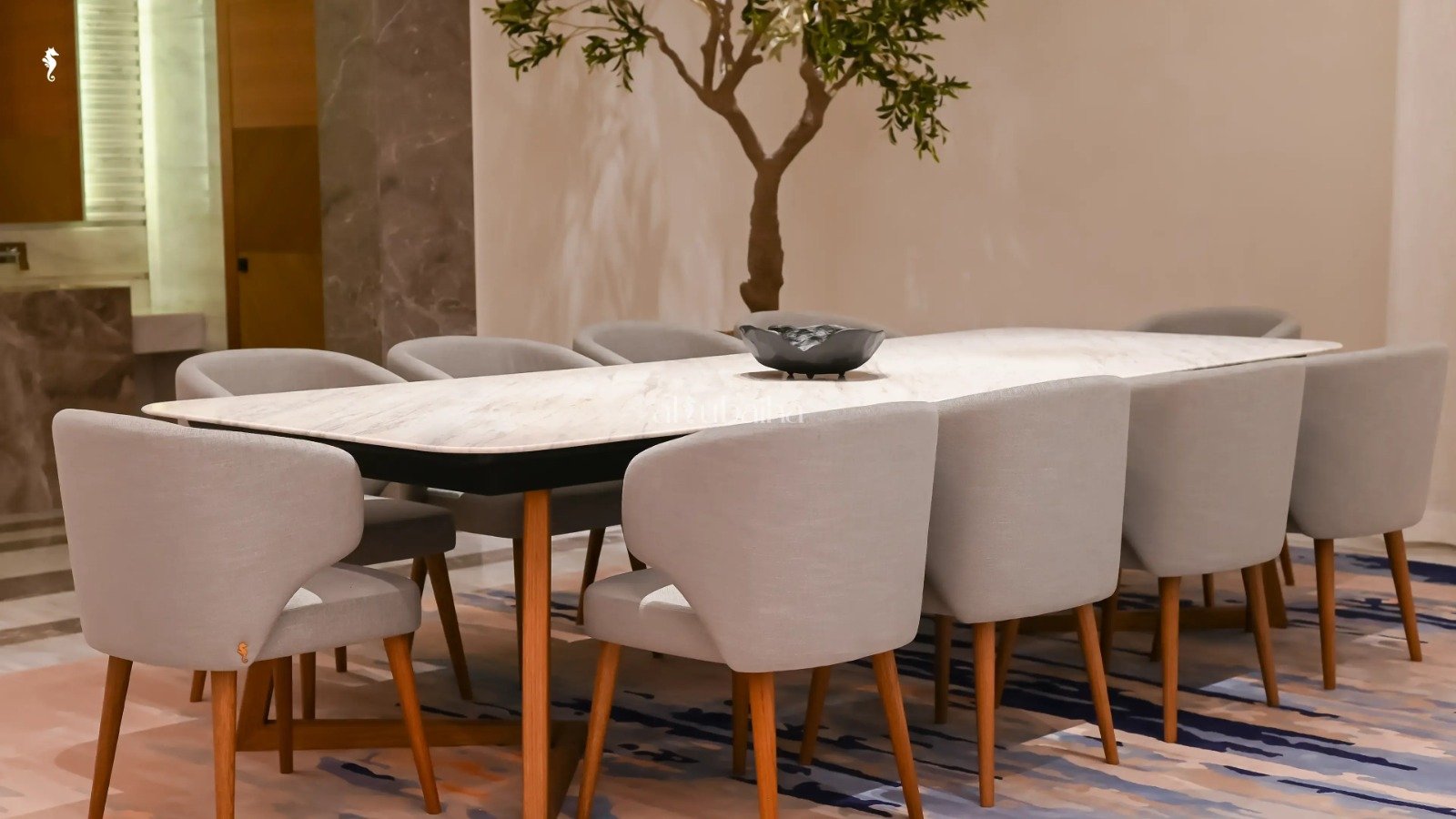
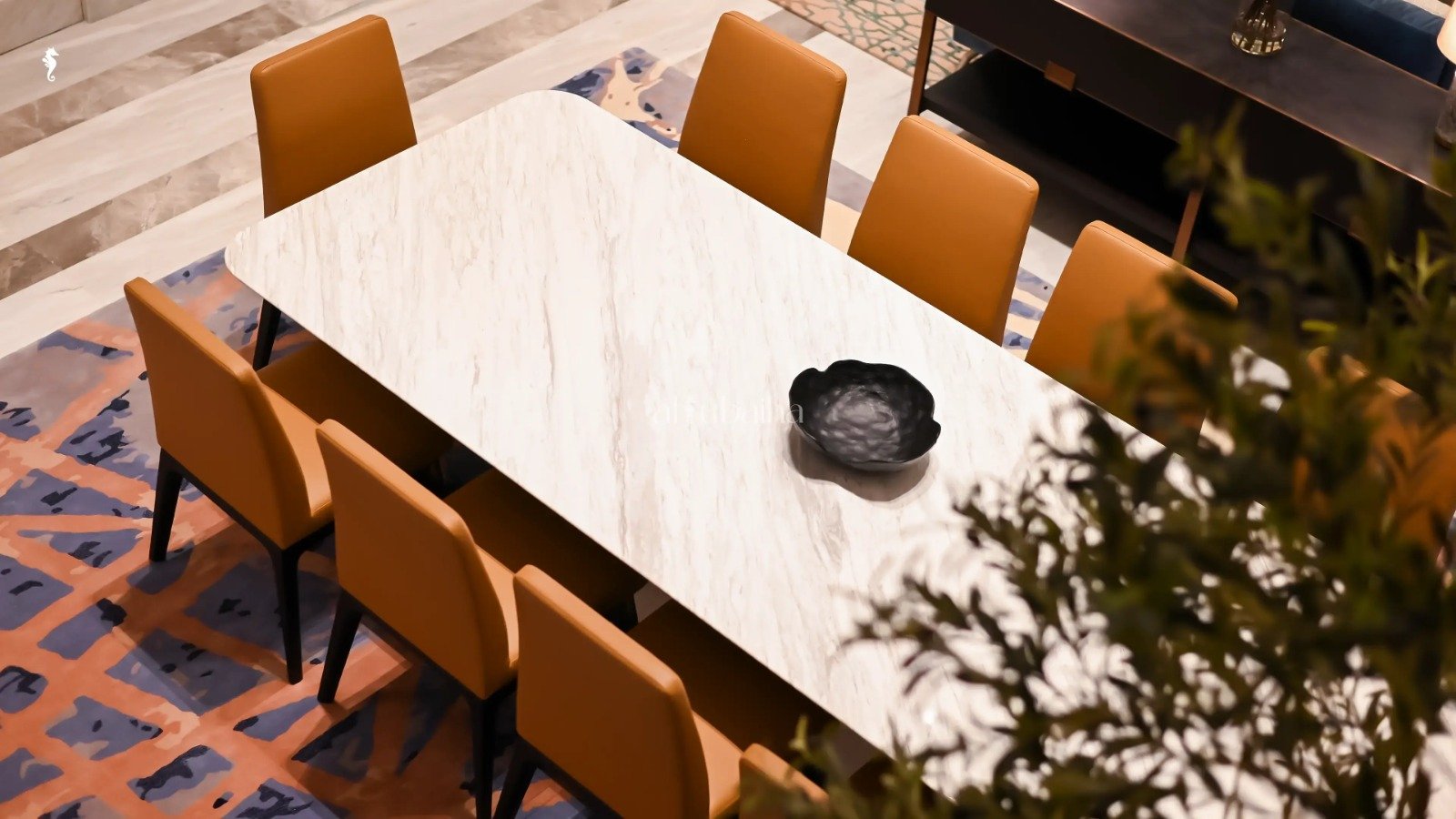
Rectangular tables maximise seating count for a given floor area and suit the linear proportions of most villa dining rooms. They work in bilateral symmetry — the same number of chairs on both long sides — and are the most versatile shape for formal hosting.
Round tables are exceptional for intimate gatherings and smaller dining rooms. They encourage conversation because everyone faces everyone else. The limitation: a round table large enough to seat 8 comfortably (minimum 150 cm diameter) requires significant floor area because the circular footprint wastes corner space that a rectangular table would use.
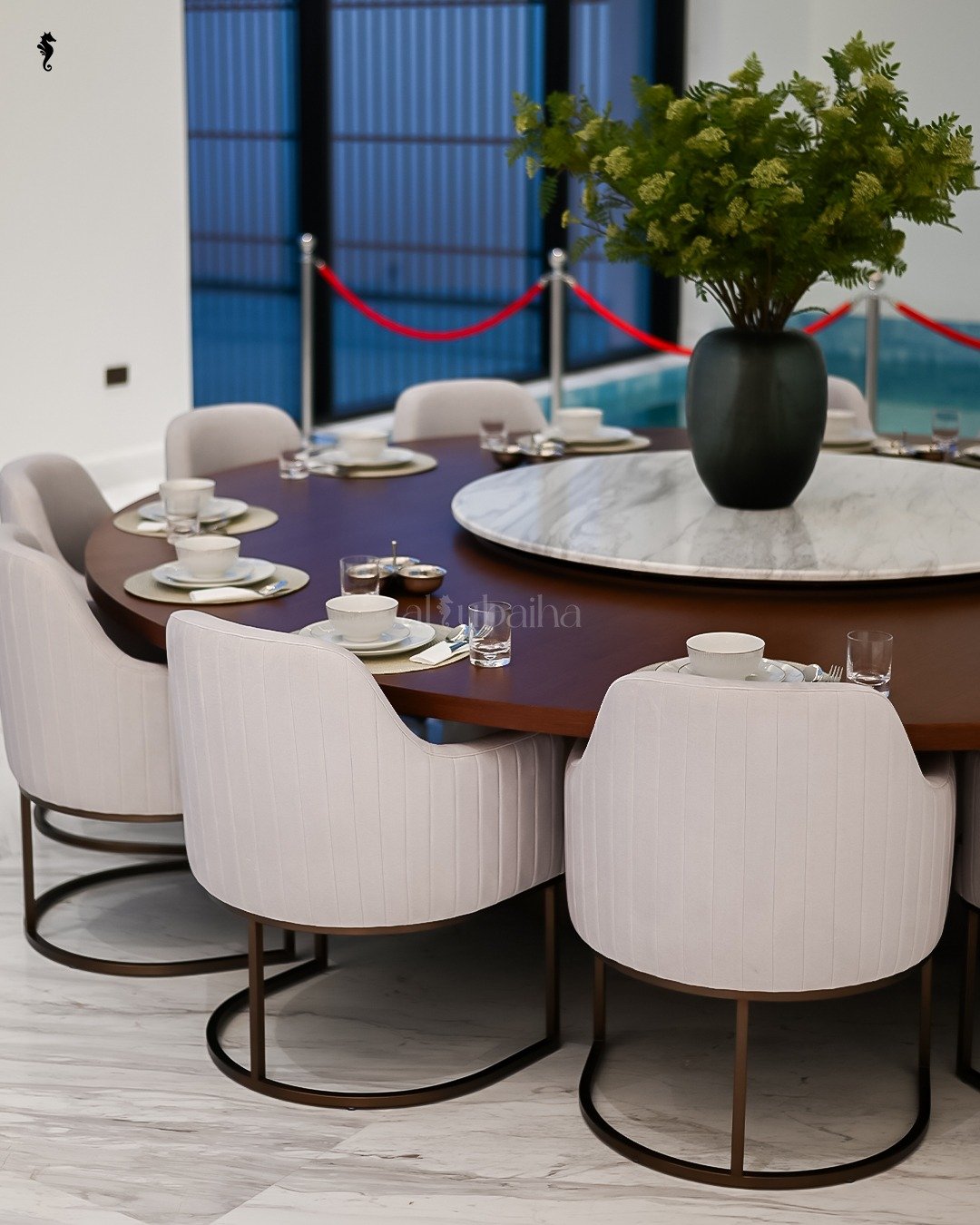
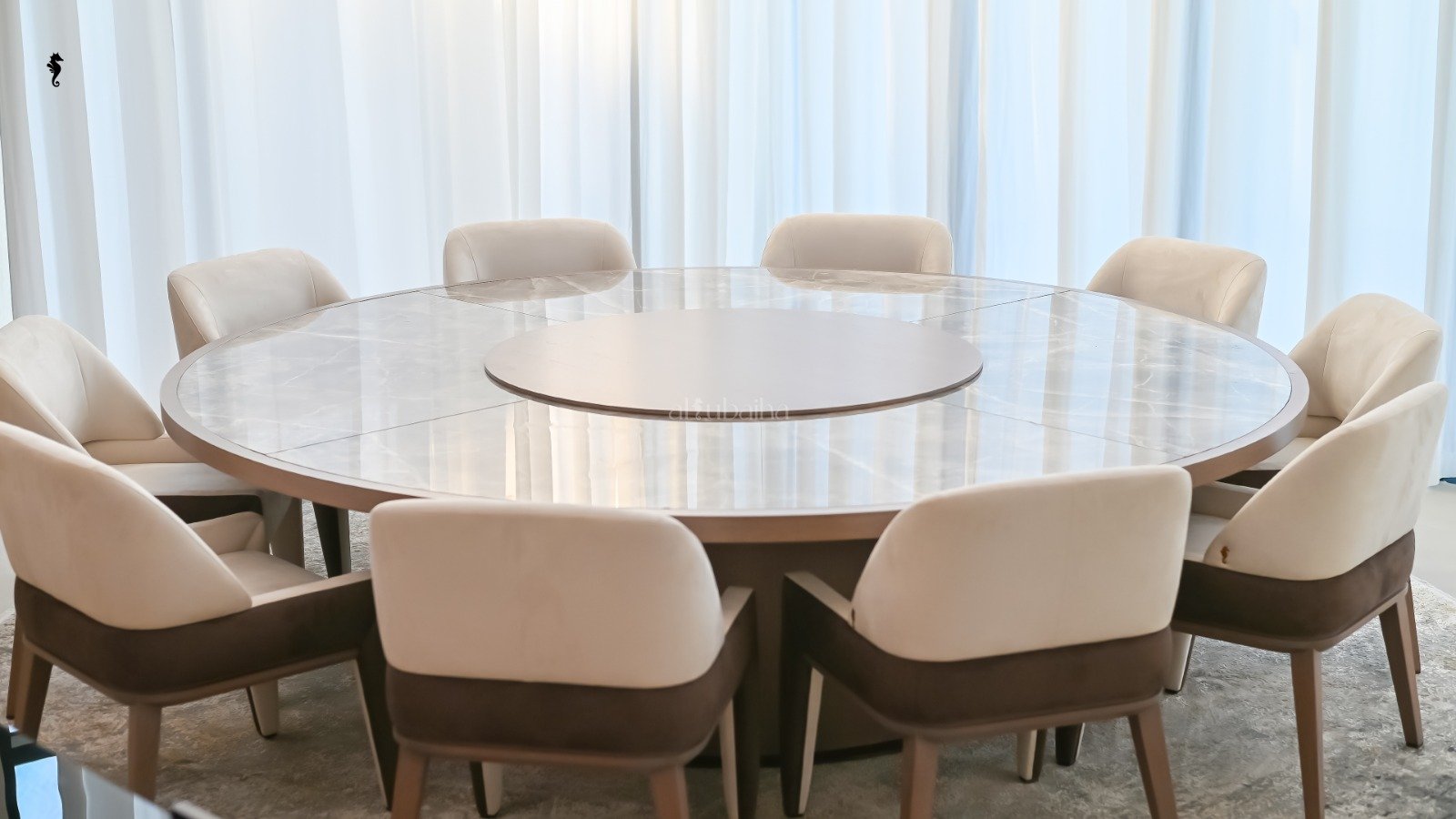
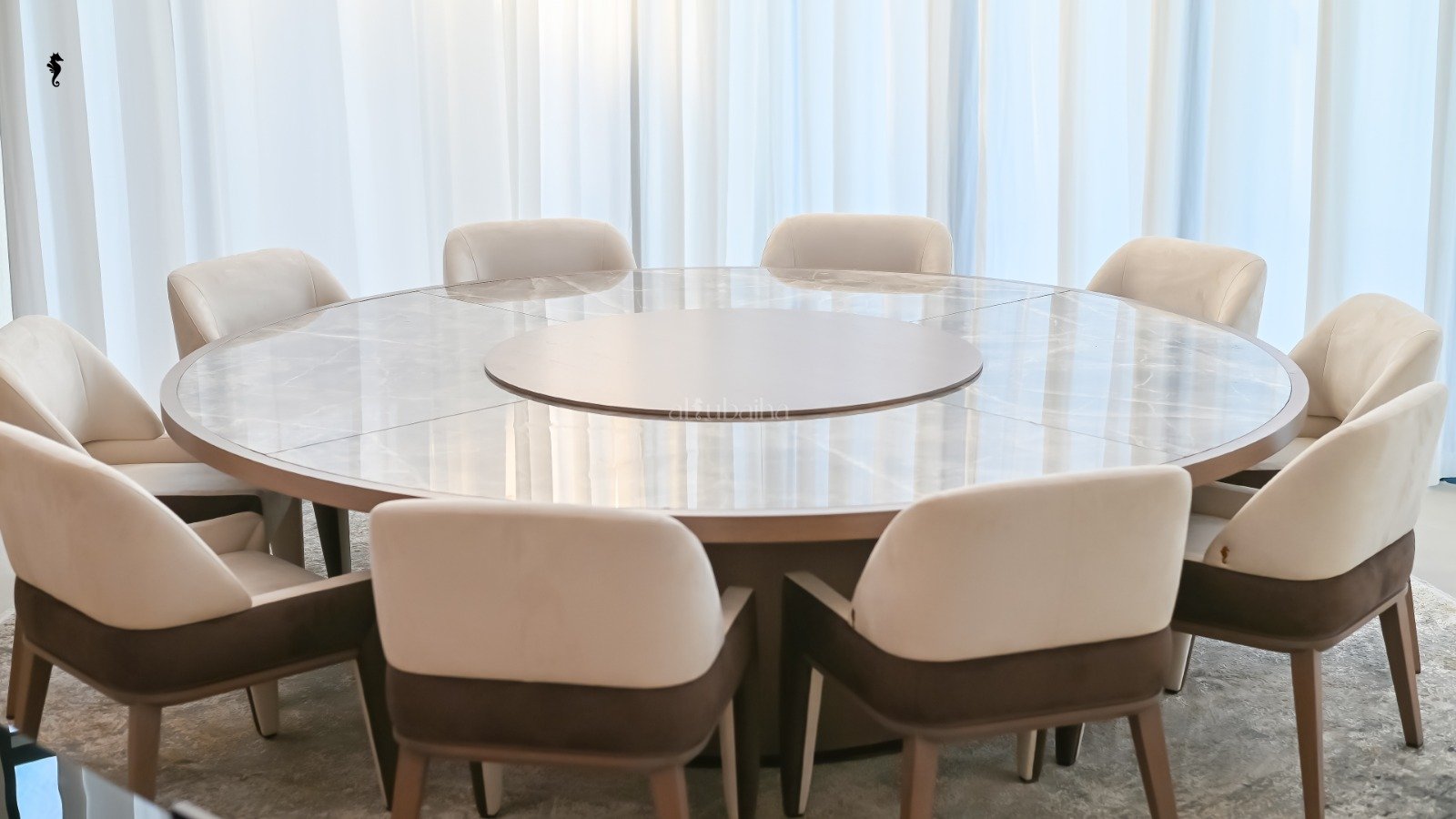
Oval tables are the premium choice — they combine the seating efficiency of a rectangular table with the visual elegance of a round table, and they eliminate the sharp corners that can be a hazard in dining rooms with children. The rotating marble lazy susan dining table in our Liwa Abu Dhabi royal estate commission — seating twelve or more — was oval precisely because that shape allowed maximum guest count while maintaining the visual refinement that the estate demanded.
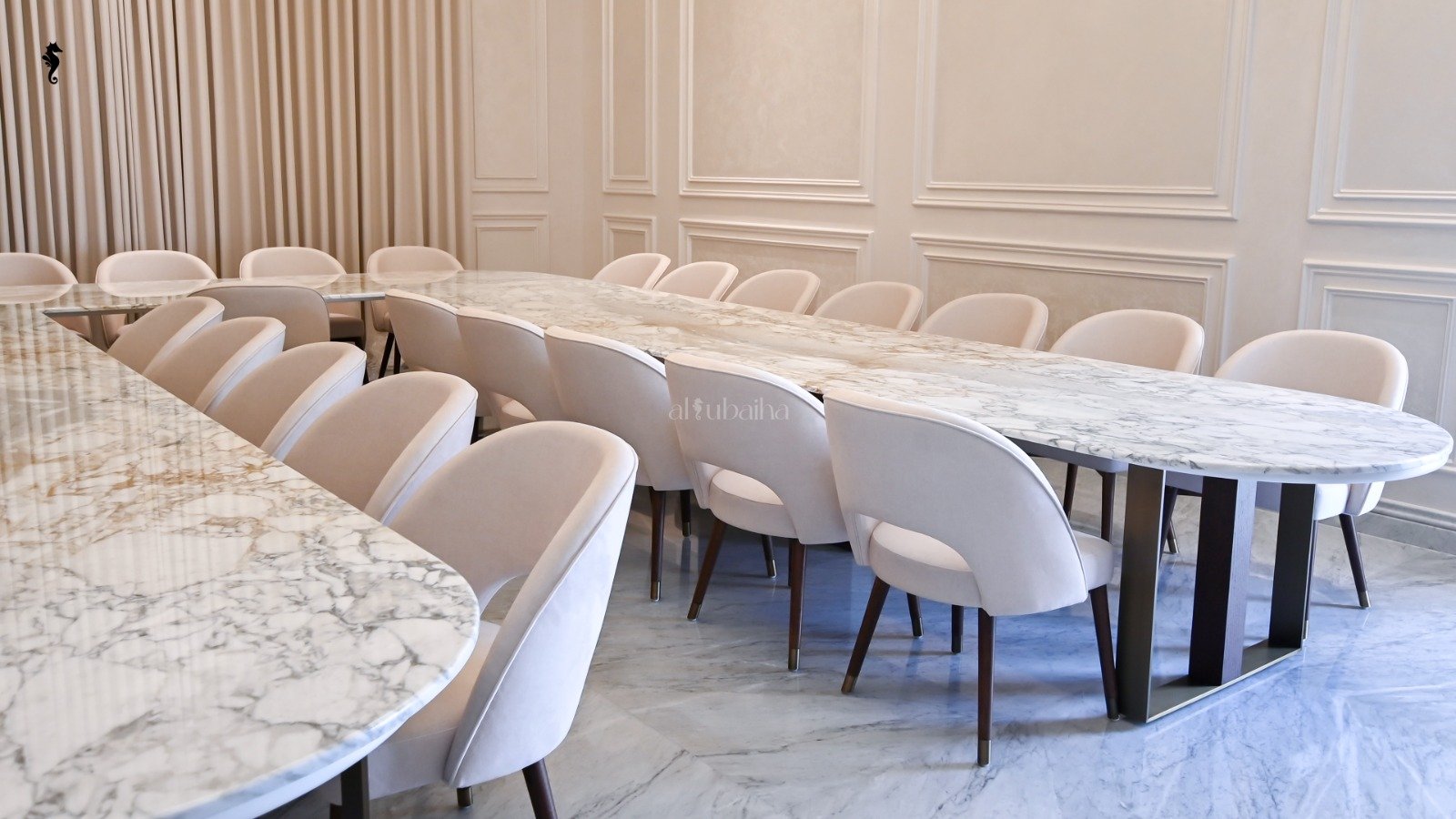
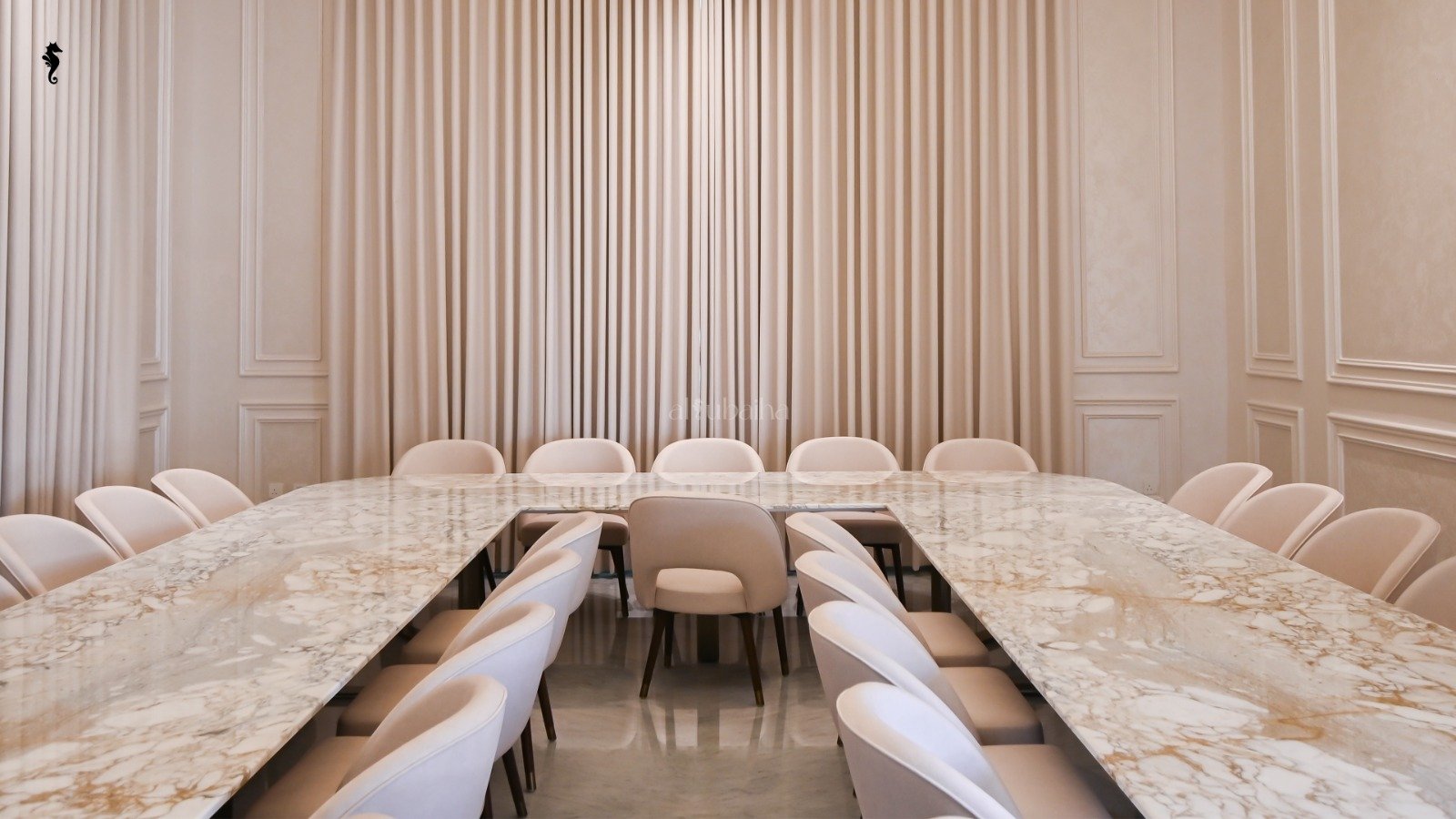
U-shape dining configurations — three tables arranged in a U — are a traditional UAE banquet format for very large guest counts. Our Al Jurainah, Sharjah VIP Majlis project used exactly this configuration: three large dining tables in a U-shape seating over 30 guests, keeping the host at the centre of the experience.
Step 2 — Choose Your Table Material
This is where the most expensive long-term mistakes happen. Here is the honest assessment of every material option — with the UAE-specific maintenance reality that showroom sales staff never tell you.
Marble — Visually Unmatched, But Requires Sealing
Marble is the most beautiful natural stone for a dining table. It is cool to the touch, veined with natural character, and carries a visual authority that no engineered material fully replicates. In the right room — formal dining, controlled environment, careful use — marble is exceptional.
The UAE reality of marble. Marble is calcium carbonate. It reacts chemically with anything acidic — lemon juice, tomato sauce, vinegar, olive oil, coffee, orange juice. All of these leave permanent etch marks on unsealed or poorly sealed marble. In a UAE household where Arabic food, fresh juice, and daily coffee are part of every meal, an untreated marble dining table will show damage within months.
The solution — high-quality stone sealer, applied correctly. A professional penetrating stone sealer applied to the marble surface before use fills the pores of the stone and creates a barrier against liquid penetration. This is not optional on a marble dining table. At Al Subaiha, every marble dining table we deliver is sealed before installation. We recommend resealing annually for dining surfaces in regular use.
Additional protection — a clear glass top. A custom-cut clear glass top (minimum 10mm, polished edges) fitted over the marble surface gives the visual appearance of the marble while protecting it from daily contact. The glass can be wiped clean of any liquid without risk of staining the stone below. This is particularly useful for households with children or where the table is used daily for every meal.
Natural stone for Al Subaiha's dining table commissions is sourced through GLAZE Granite & Marble — based in the same Al Sajaa Industrial Area in Sharjah — with direct quarry relationships in Italy and Greece and over 400 marble, granite, and quartzite varieties available.
Engineered Stone (Quartz) — The Intelligent Durability Choice
Engineered quartz is the most underspecified material in UAE luxury dining tables — and the most practical.
Quartz is composed of 90–95% natural quartz crystals bound in resin. The result is a surface that is non-porous, acid-resistant, heat-resistant to a point, and virtually impossible to stain under normal dining conditions. Unlike marble, quartz does not require sealing. Coffee, lemon juice, tomato sauce, olive oil — all wipe clean without etching or staining.
The visual reality. High-quality engineered quartz — particularly the Italian and Spanish manufacturers represented in the UAE market — is visually indistinguishable from natural marble at any normal viewing distance. The veining is engineered but convincing, and the surface finish is consistent in a way that natural stone is not.
Where quartz wins over marble: families with children, households where the dining table is used for every meal, outdoor dining areas, and any client who wants stone aesthetics without the maintenance commitment.
Where marble wins over quartz: formal dining rooms used primarily for entertaining rather than daily family meals, and clients for whom the unique natural character of real stone is important.
Sandblasted and brushed quartz finishes — increasingly specified in UAE luxury dining commissions — provide a matte, tactile surface that reads as significantly more luxurious than polished quartz and does not show fingerprints or watermarks. This is the finish to specify if you want quartz to feel as premium as it looks.
Solid Wood — The Most Forgiving Long-Term Choice
Solid wood is the most practically intelligent material for a UAE villa dining table that will be used daily.
Why solid wood is exceptional for dining tables. A scratch on a solid wood dining table is not a disaster — it is a minor maintenance task. Solid wood can be lightly sanded and repolished to a like-new finish for a fraction of the cost of any stone repair. This cannot be done with marble, quartz, glass, or veneer. It is the unique advantage of solid wood that no other dining table material shares.
The most durable solid woods for UAE dining tables are teak, walnut, white oak, and red oak. Teak is particularly suited to UAE conditions because of its natural oil content — it resists humidity fluctuation and temperature variation better than most other species.
The patina argument. Solid wood develops character with use in a way that no other material does. The surface deepens in tone and develops a patina over years of use that reads as genuinely aged and quality — not worn or damaged. A walnut dining table in 15 years looks better than it did on delivery day.
Specification. For a luxury UAE villa dining table, specify solid hardwood at a minimum of 40mm thick for the tabletop — anything thinner risks warping in the UAE's AC-heavy indoor climate. Kiln-dried timber is essential — undried timber will warp and split as it adjusts to the indoor humidity level.
The rotating marble lazy susan dining table in our Liwa Abu Dhabi estate project used a solid walnut-stained wood base — chosen specifically because the precision engineering required to seat a flush rotating marble panel into the tabletop demanded the dimensional stability and workability of solid wood. No other material could have achieved that result.
Veneer — Visually Rich, But Protect It
Wood veneer dining tables — thin slices of premium hardwood bonded to an engineered core — offer the visual richness of solid wood at a lower cost and with greater dimensional stability. A veneer tabletop in figured walnut or burr oak can be visually exceptional.
The critical protection requirement for veneer: fit a custom clear glass top, minimum 10mm toughened glass with polished edges, over the veneer surface. Veneer cannot be sanded and repolished like solid wood. A deep scratch or heat mark on veneer is permanent damage that requires panel replacement — an expensive process. A clear glass top eliminates this risk entirely. The veneer is visible through the glass. The surface is protected. The aesthetic is fully preserved.
Never use a veneer dining table in UAE without a glass top. Hot dishes placed directly on veneer cause permanent white heat marks. Spilled liquid that sits on veneer for more than a few minutes can cause the veneer to bubble and lift. These are not rare events in a dining room — they are certainties over time.
Glass — Minimum 20mm Tempered, No Exceptions
A glass dining table in a UAE villa can work beautifully in the right context — a contemporary interior, a room where the visual lightness of glass is the specific design intention, or a smaller dining space where a solid stone or wood table would feel heavy.
The specification that is non-negotiable: minimum 20mm fully tempered glass for any dining table top that will carry the weight of serving dishes and the mechanical stress of daily use. This is not a luxury upgrade — it is a basic safety requirement.
Below 20mm, glass dining tables flex perceptibly under load — you can feel it when placing heavy serving dishes. This flexing creates micro-stress in the glass that compounds over time and increases the risk of spontaneous stress fracture. A 12mm or 15mm glass dining table that shatters during a family meal is not a product failure — it is a foreseeable consequence of inadequate specification.
Fully tempered glass shatters into small, relatively harmless cubes rather than dangerous shards. Heat-strengthened glass — often confused with tempered — does not provide the same safety performance. Ask for the tempering certificate.
Edge profile for glass dining tables. A flat polished edge reads as clean and contemporary. A bevelled edge adds visual weight. A pencil-rounded edge is the safest option for households with children — it eliminates the sharp 90-degree corner that a flat polished edge creates.
Step 3 — Choose the Right Base
The table base determines the visual character of the table and — more practically — how many people can sit around it comfortably.
Four-leg base. The most stable and most traditional configuration. Works at every size. The limitation: legs at the four corners of the table restrict end seating — the two people at the short ends have a leg in their way. For tables under 200 cm where end seating is important, consider a trestle or pedestal base instead.
Pedestal base (single or double column). A single pedestal base gives completely unobstructed leg room for every seat including the ends. Best suited for round and oval tables up to 150 cm diameter — a single pedestal on a very large rectangular table will be structurally inadequate. Double pedestal — two column bases at each end — provides unobstructed leg room for all seats on a large rectangular table while maintaining structural integrity.
Trestle base. Two support structures at the ends of the table, connected by a central stretcher. Provides full leg room on all four sides without the structural risk of an undersized pedestal on a large table. Increasingly specified in UAE luxury dining commissions for its architectural visual quality.
Metal base — the UAE luxury standard. Solid metal bases — particularly electroplated bronze, brushed gold, or blackened steel — are the dominant specification for luxury UAE villa dining tables in 2026. The metal base provides visual contrast against stone or wood tops and reads as considered and architectural. The bronze electroplated bases in the Liwa Abu Dhabi estate dining room tied the dining zone directly to the bronze material language running across the coffee tables, side tables, and majlis furniture throughout the estate.
Base material for outdoor dining. For outdoor or poolside dining areas in UAE villas, specify 316 marine-grade stainless steel bases only. Standard 304 stainless will eventually show rust in coastal outdoor environments. Powder-coated aluminium is an acceptable alternative for outdoor use.
Step 4 — The Dining Chair Decision
The dining table does not exist in isolation. The chairs sitting around it are the second most important visual element in the dining room — and the most important functional one.
Upholstered vs non-upholstered. Fully upholstered dining chairs are significantly more comfortable for long meals and extended hosting — a key UAE consideration where family gatherings can last 3–4 hours. Specify FibreGuard-certified performance fabric for any upholstered dining chair that will see regular use. UAE dining events involve food, drink, and children — an unprotected fabric dining chair will show staining within one hosting season regardless of how carefully guests behave.
Chair height. Standard dining chair seat height is 44–48 cm for a standard 75–77 cm dining table. Always verify chair seat height against table height before specifying. A mismatch of more than 5 cm creates a seating position that is either too cramped or too low for comfortable dining.
Chair depth and the table clearance calculation. A standard dining chair with arms requires approximately 60–65 cm of table edge space. A chair with significant armrests may require 70–75 cm. Calculate your seating count from these numbers, not from dividing the table length by an arbitrary figure.
Arm chairs vs side chairs. In a formal UAE dining configuration, arm chairs are typically reserved for the host and co-host positions at the head of the table. Side chairs — without arms — run along the long sides. This is the configuration used in the Al Jurainah Sharjah VIP Majlis dining suite — custom tub chairs with arms at the ends, side chairs along the length.
Step 5 — The Buffet and Serving Station
A dining room without a serving surface is incomplete in a UAE villa context. The buffet — the serving station positioned against the wall of the dining room — is as important to the function of the room as the table itself.
Size the buffet to the wall, not to the table. A buffet that is too short for its wall leaves the wall looking bare. A standard buffet height of 85–90 cm allows it to function as a serving surface while seated guests at a 75 cm table can reach across it comfortably.
Material consistency. The buffet material should connect to the dining table. If the table is walnut, the buffet is walnut. If the table has bronze metal legs, the buffet has bronze metal legs. This is not a decorative preference — it is what makes a dining room read as designed rather than assembled.
The bespoke L-shape buffet in our Liwa Abu Dhabi estate was a continuous cognac-stained solid wood commission with a seamless marble top running the full length of both arms — no visible joins at the corner transition, flush-fit push-to-open doors with no visible hardware, and bronze metal legs matching every other piece in the estate. That level of material consistency across a buffet of that scale is only achievable when a single manufacturer controls the full commission.
The 6 Most Common Dining Table Mistakes in UAE Villas
1. Wrong table size for the room. The single most common mistake. A table sized for a European apartment in a UAE villa dining room looks like it belongs in a different house. Always size from the room first, not from the showroom.
2. No glass top on a veneer table. Veneer cannot be repaired like solid wood. Without a glass top, the first hot dish placed directly on the surface creates a permanent white heat mark. Protect veneer — always.
3. Unsealed marble. Unsealed marble in a UAE dining room will stain. It is a question of when, not if. Seal before use, reseal annually, and consider a clear glass top for daily-use surfaces.
4. Underspecified glass. A 12mm glass dining table in a UAE villa is a liability. 20mm fully tempered is the minimum. Ask for the certificate.
5. Too many chairs for the table size. Seating 12 around a table sized for 8 does not create more hosting capacity — it creates an uncomfortable experience that guests remember. Calculate seating count from the 60–65 cm per person rule and do not compromise it.
6. Mismatched chair height. Buying a beautiful dining table and chairs separately without checking that the seat height works against the table height is a common and entirely avoidable mistake. Standard pairing is 44–48 cm chair seat height to 75–77 cm table height.
Frequently Asked Questions
What is the standard dining table height in UAE? 75–77 cm is the international standard for dining table height and the correct specification for any UAE villa dining table. Ensure your dining chairs have a seat height of 44–48 cm to pair correctly.
How do I protect a marble dining table from staining? Apply a professional penetrating stone sealer before first use and reseal annually. For maximum protection, fit a custom clear tempered glass top over the marble surface. Wipe liquid spills immediately — do not allow acidic liquids to sit on unsealed marble for more than a few seconds.
Can a solid wood dining table be repaired if it gets scratched? Yes — this is one of solid wood's greatest practical advantages. Surface scratches on solid wood can be sanded lightly and repolished to a like-new finish by any competent furniture restoration professional. The cost is minimal compared to replacing a marble or glass top damaged by a similar level of impact.
What is the difference between marble and quartz for a dining table? Marble is natural stone — visually unique, cool to touch, and requires sealing and careful maintenance. Quartz is engineered stone — non-porous, acid-resistant, stain-resistant, and requires no sealing. Both can look visually similar at a distance. Quartz is the more practical choice for daily-use dining surfaces. Marble is the more prestigious choice for formal dining rooms used primarily for entertaining.
How long does a custom dining table take to manufacture at Al Subaiha? 6–10 weeks from confirmed specification and material selection to white-glove delivery and installation. Technically complex commissions — such as tables with rotating marble inserts, integrated lazy susans, or very large one-piece stone tops — require additional lead time.
Does Al Subaiha deliver dining tables outside the UAE? Yes. Al Subaiha delivers and installs across all seven UAE emirates and internationally worldwide. Whether your villa is in Dubai, Abu Dhabi, Saudi Arabia, Europe, or beyond — our team manages the full delivery and installation process to your location.
Can I commission a full dining room — table, chairs, and buffet — as one package? Yes. Al Subaiha manufactures the complete dining room as a unified commission — dining table, dining chairs, buffet or serving station, and any additional storage pieces — all manufactured in-house to a single material standard. The result is a dining room where every piece connects, not a room assembled from separate purchases.
Real Projects — What Luxury Dining Manufacturing Looks Like
Liwa, Abu Dhabi — Rotating Marble Lazy Susan Dining Table (Delivered 2026)
One of the most technically demanding single pieces Al Subaiha has ever manufactured. A large oval dining table in solid walnut-stained wood with a central rotating marble lazy susan precision-engineered flush into the table surface. At a scale seating twelve or more guests, achieving a smooth-action rotating marble panel set flush into a solid wood table — permanently stable, without visible hardware — represents the upper limit of custom furniture manufacturing capability in the UAE.
Custom channel-pleated barrel-back dining chairs in cream upholstery on curved bronze base legs completed the dining zone — the same vertical pleating detail and bronze material tone connecting the dining room to the broader estate material language.
View the full Liwa Abu Dhabi VIP Estate project →
Al Jurainah, Sharjah — U-Shape Royal Banquet Dining Suite (Delivered 2025)
Three massive dining tables arranged in a strategic U-shape configuration, maximising floor space while keeping the host at the centre of the experience. Custom tub-style dining chairs upholstered in premium leather, supported on solid wood legs with a metallic gold finish — a deliberate material decision that connected the dining zone to the warm gold tones running through the adjacent VIP majlis.
View the Al Jurainah VIP Majlis project →
See It in Our Projects
Every piece below was designed and built in our Sharjah factory for a real home in the UAE. Click a project to see the full gallery, or open any piece to view it in detail.
Full Bespoke Villa, Al Ain
Every piece in the villa made to order with InDetails Decoration, completed in four months. Pieces from this project: Sartoria Quadro armchair, Sartoria Starto coffee table, Sartoria Tripod side table, Sartoria Monolith dining table, Sartoria Linea console table, Sartoria Coda dining chair, Sartoria Zaffiro sofa.
Villa with DAL Interiors, Masaar, Sharjah
Daniah Mohammed's 'no sharp angles' brief, carried through every sofa, table and chair. Pieces from this project: Sylvara Curve armchair, Virello Chair, Terra Arc dining table, Lumi Sofa.
VIP Estate and Royal Majlis, Liwa, Abu Dhabi
A full VIP estate, from the exterior majlis to the dining room and executive office. Pieces from this project: Ivory Nova sofa, Ivory Edge coffee table, Ivory Frame side table, Ivory Mist armchair.
Browse the collections: Dining tables · Dining chairs · Buffets and sideboards · Console tables · All projects
Commission Your Dining Table with Al Subaiha
Al Subaiha Furniture IND LLC has been manufacturing bespoke luxury dining tables, dining chairs, and full dining room commissions in Sharjah, UAE since 1994. We have the manufacturing capability, the material library, and the 32 years of UAE-specific experience to build a dining table that is right for your room — not a showroom piece adapted to fit it.
We deliver worldwide. Whether your villa is in Dubai, Abu Dhabi, Saudi Arabia, Europe, or beyond — our team manages the full delivery and installation process to your location.
The process starts with a factory visit and free consultation at our Al Sajaa facility in Sharjah — two to three hours that will change how you think about what you are commissioning.
Start your dining table commission →
Explore our completed villa and dining projects in our project gallery →
Further reading:
Al Subaiha Furniture IND LLC — Al Sajaa Industrial Area, Sharjah, UAE. Since February 1994. +971 56 392 1697 · info@alsubaiha.ae · alsubaiha.ae