
By Amjath Marolly, CEO — Al Subaiha Furniture IND LLC
The dining table is the most used piece of furniture in a UAE villa. It is where the family sits every day, where guests are entertained, and where the quality of a home's interior is judged up close — not from across a room, but at arm's length, over a meal. A dining table that is the wrong size, the wrong height, or the wrong material for how it will actually be used is a problem you live with every single day.
Yet it is the room that most furniture buyers get wrong. The common mistake is buying a dining table that looks correct in a showroom or in a photograph, without accounting for the specific dimensions of their villa's dining room, the number of people it needs to seat regularly, and the conditions it will face in UAE daily life — heat, humidity, frequent hosting, and domestic staff cleaning routines that standard furniture finishes do not always survive.
This guide covers everything you need to decide before ordering a custom dining table in the UAE, so the piece you receive works as well on year five as it does on day one.
The First Decision: How Many People Does Your Dining Table Actually Need to Seat?
Not the number for a dinner party — the number for a regular family meal.
This distinction matters because most UAE villa owners oversize their dining tables. They plan for the occasional large gathering, which means they live daily with a table that is too large for the room, leaves too much empty space in the centre, and makes regular family meals feel scattered rather than gathered.
The practical approach is to size for your regular household and plan for extension when needed. A well-designed custom dining table can include a concealed extension mechanism that adds 50–80 cm to the length, accommodating larger gatherings without compromising the proportions of daily use. This is a feature to request specifically at the design stage — it cannot be added after the table is built.
Standard seating space per person is 60 cm of table width. A family of six needs a minimum of 180 cm in length for comfortable daily seating. For eight, 220–240 cm. For ten, 280 cm or more. These are minimum figures — go 20 cm longer wherever the room allows it, because overcrowded dining tables are more uncomfortable than slightly oversized ones.
Dining Table Sizes for UAE Villas — By Villa Type
UAE villa dining rooms vary considerably in scale, and the right table size for each is different.
Town house or small villa (dining room 300–400 cm × 350 cm): A table of 180–220 cm × 90–100 cm seats 6–8 comfortably. A round table of 130–150 cm diameter works well where the room is more square than rectangular.
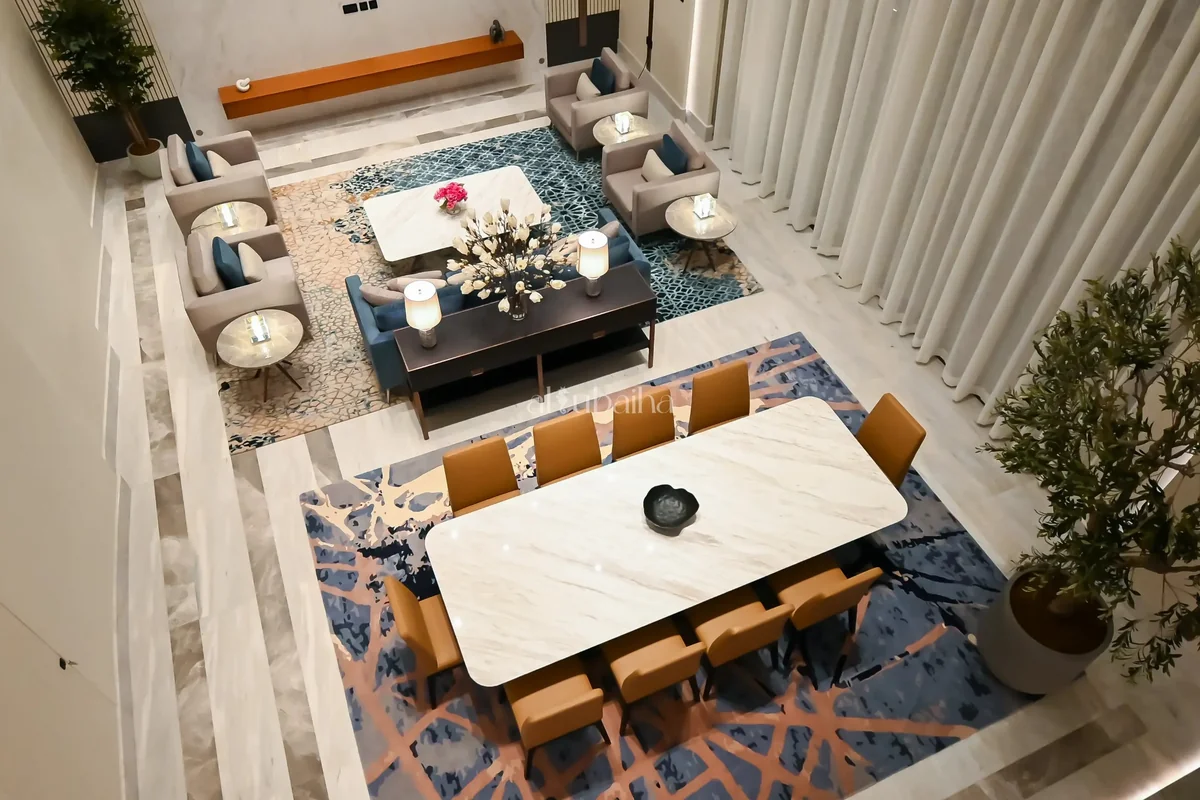
Medium villa (dining room 400–500 cm × 400 cm): A table of 240–280 cm × 100–110 cm seats 8–10. This is the most common size in UAE villa projects — large enough for regular hosting, proportionate to a standard double-height dining room.
Large villa or palace-scale dining room (500 cm and above): Tables of 300–400 cm or more. At this scale, the table becomes an architectural element of the room rather than simply a piece of furniture, and the base design, material finish, and chair specification need to work at that scale.
One rule applies across all sizes: leave a minimum of 90 cm between the edge of the table and any wall or furniture. 90 cm is the minimum clearance for a person to push back their chair and stand comfortably. 110 cm is more practical where domestic staff will be serving from the side.
Shape: Rectangle, Round, or Oval
Rectangle is the right choice for most UAE villa dining rooms. It aligns with the room's architecture, seats more people per square metre than a round table, and works better for serving dishes family-style across the centre.
Round works well in a dining room where the space is more square than rectangular, and in households where conversation across the table is the priority over formal hosting. A round table of 150 cm diameter seats 6 adults comfortably. Beyond that diameter — 180 cm and above — the centre of a round table becomes dead space that no one can reach, and the table begins to function poorly for serving.
Oval is a practical compromise that is underused in UAE dining rooms. It has the visual warmth of a round table and the seating efficiency of a rectangle. It eliminates corners, which matters in tighter rooms where guests at the ends of a rectangular table sit further from the group. If you are deciding between round and rectangular and cannot commit, oval is usually the right answer.
The Table Top: Material Decisions That Matter in UAE Conditions
The UAE's climate and typical household conditions are specific. Temperatures and humidity variations between air-conditioned interiors and outdoor conditions are extreme. Domestic staff cleaning routines often involve stronger cleaning products than European or American households use. Any material specification needs to hold up to these conditions, not just look good in a temperature-controlled showroom.
Solid Wood
The most requested material, and the right choice when specified correctly. The important point is moisture movement: solid wood expands and contracts with humidity changes, which in UAE conditions — where interior humidity can swing considerably between summer and winter — means the table top specification must account for this. A properly constructed solid wood dining table uses appropriate joinery methods to allow the wood to move without cracking. A poorly constructed one — common in lower-end custom work — develops cracks within the first year as the wood responds to the environment. Ask specifically how the top is constructed, not just what wood species is used.
The most durable hardwoods for UAE conditions: teak, walnut, white oak. Teak in particular has a natural oil content that handles humidity well and resists the repeated wet-cleaning that dining tables in active households receive.
Marble and Stone
Marble dining tables are popular in the UAE market and appropriate for formal dining rooms used primarily for entertaining. The practical considerations: marble is porous and stains permanently if acidic liquids — citrus juice, coffee, wine — are left on the surface. It requires sealing on delivery and periodically thereafter. It is also heavy — a 240 cm marble top can weigh 200 kg or more, which affects the base specification and delivery logistics. For a family dining room used daily with children, marble requires a maintenance commitment. For a formal dining room used for hosting, it is an excellent choice.
Lacquered MDF or Engineered Wood
High-gloss lacquer on MDF is a valid choice for a contemporary dining room and handles UAE conditions well when the lacquer is applied correctly. The finish is non-porous, easy to clean, and resistant to humidity in a way that raw wood is not. The risk is edge damage — lacquered edges chip when hit, and chips are visible. Specify a solid wood edge banding on any lacquered dining table, not a lacquered MDF edge, to reduce this vulnerability.
Glass
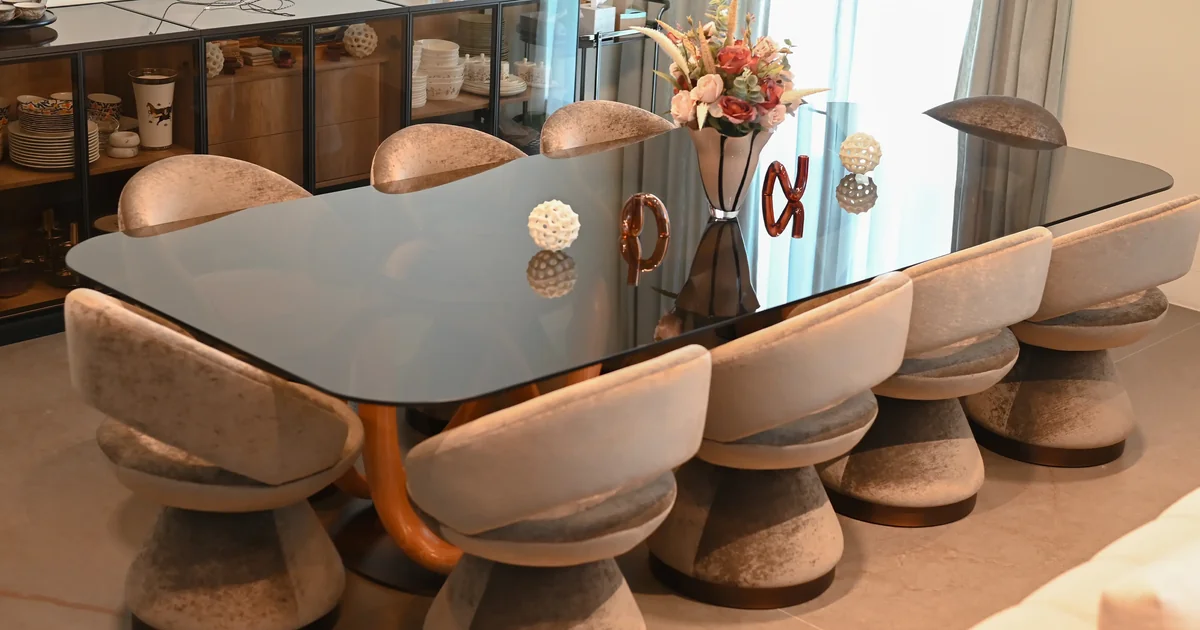
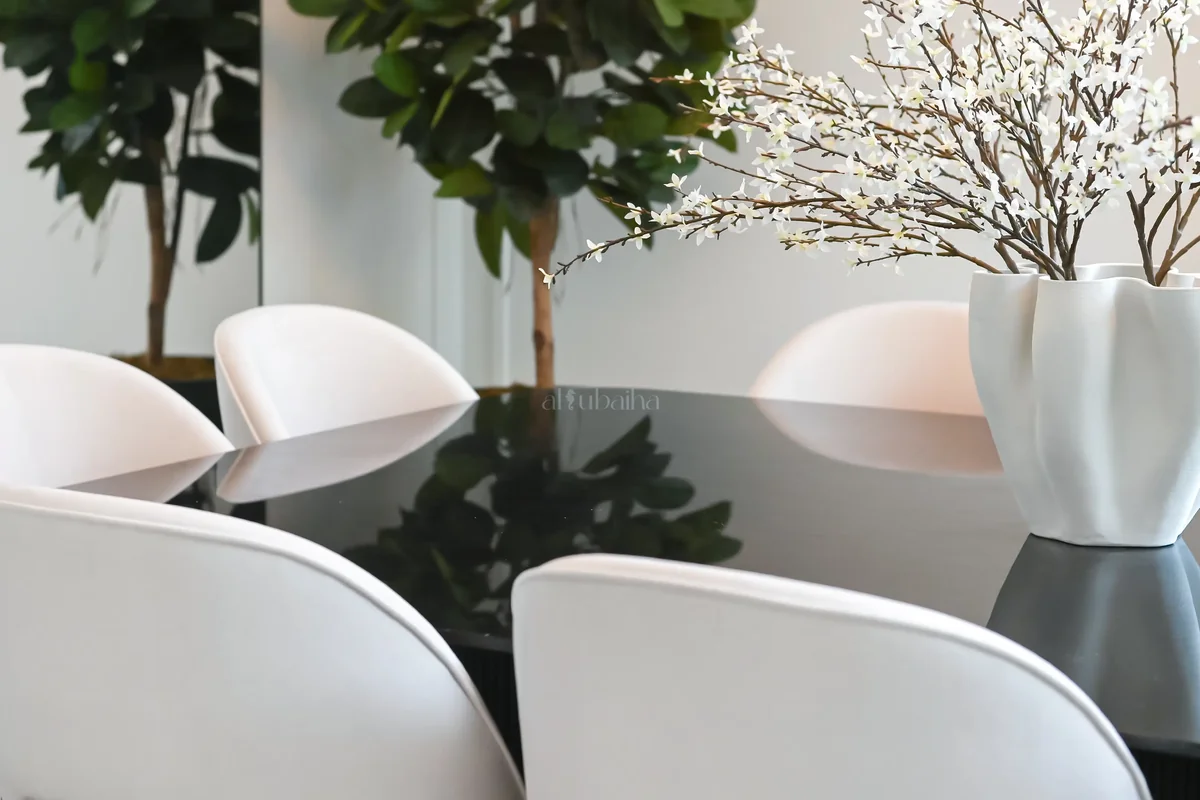
Tempered glass tops are used in contemporary dining rooms where the visual lightness of the material is part of the design intention. The practical limitation is fingerprints, water marks, and the need for regular polishing to maintain the surface. In households with children or frequent daily use, glass tops require more maintenance than any other option. Frosted glass is a more practical variant — it shows marks less than clear glass and diffuses the visual weight of the base beneath.
The Base: What Holds the Table Matters as Much as What Covers It
The base is the structural element of the dining table and the one that most affects how the table functions over time.
Four-leg bases are the most stable and the easiest to seat around — there are no central supports obstructing leg space. The limitation is that four-leg bases fix the seating positions at the corners; adding an extra chair at the corner position is awkward. For a table used frequently at exactly the same capacity, four legs are ideal.
Pedestal bases (single or double column) allow complete flexibility in chair placement, which matters for a table that varies in capacity from 4 to 12 depending on the occasion. The trade-off is stability — a single pedestal under a 240 cm table will flex, and that flex is felt as movement when someone rests their forearm on the end of the table. A double pedestal base solves this. Single pedestal is appropriate only for tables up to around 160 cm in length.
Trestle bases (a horizontal beam supported by two vertical frames) are well-suited to contemporary interiors and handle large table dimensions well. They allow full leg room across the length of the table and are structurally very rigid. The visual weight is higher than a pedestal base — they work best in rooms where the table is meant to be a statement piece rather than background furniture.
Dining Chairs: Matching or Mixing
The most common dining room mistake in UAE villas is sourcing the dining table from one place and the chairs from another, months apart. The result is almost always a mismatch — not in style, but in seat height relative to the table surface.
Standard dining table height in the UAE market is 75–76 cm. Standard dining chair seat height is 44–46 cm, leaving approximately 29–30 cm of clearance between seat and table surface — the minimum comfortable clearance for most adults. When chairs are sourced separately, this clearance is frequently wrong by 3–5 cm in either direction, which makes the dining experience genuinely uncomfortable even if the visual match is correct.
Specify table height and chair seat height together, from the same brief, whether you source them from the same manufacturer or not.
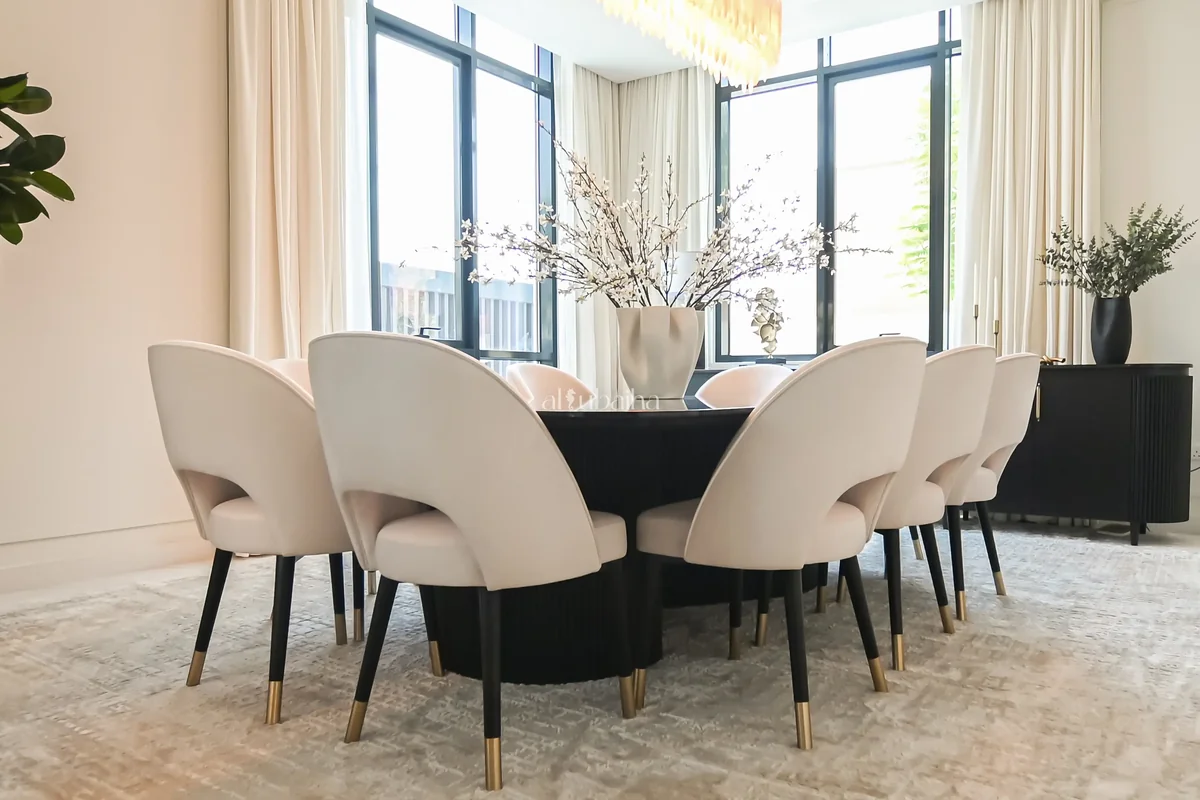
On the question of matching versus mixing chair styles: a mix of two chair types — typically an upholstered carver chair at the ends and a simpler side chair along the length — is both more practical and visually more interesting than a uniform set of eight identical chairs. The carver chairs add visual weight at the head positions and are more comfortable for the host and primary guest seats. This is worth discussing at the design stage rather than deciding after delivery.
For upholstered dining chairs in UAE conditions, use a performance fabric with a Martindale rub count of at least 30,000. Dining chairs take more concentrated wear than any other upholstered piece in the home — the seat particularly. See our fabric guide for UAE furniture for the full criteria on fabric selection.
Five Mistakes to Avoid When Ordering a Custom Dining Table in the UAE
1. Ordering Without a Room Measurement
Floor plans do not capture the actual usable space in a dining room. Built-in features, column positions, and sliding door clearances all affect the available space. Measure the room yourself before briefing a supplier, and confirm the minimum 90 cm clearance on all four sides of the proposed table footprint.
2. Prioritising Visual Impact Over Seated Comfort
A table that photographs well but seats uncomfortably — wrong height, wrong clearance, chairs that are too deep for the table — is a failed purchase regardless of its appearance. Test the seated height at the design stage, not after delivery.
3. Specifying a Finish That Cannot Survive Daily Cleaning
Ask specifically how the table should be cleaned and what cleaning products are safe on the finish. If the answer involves special products or restrictions that are incompatible with your household's routine, change the finish specification before production begins.
4. Not Specifying the Extension Mechanism at the Design Stage
An extension leaf can only be incorporated into the table's structure at the design stage. It cannot be added after the fact. If you will ever need to seat more people than the standard configuration allows, specify the extension now, even if you think you will rarely use it.
5. Buying Chairs Separately After the Table Is Delivered
Confirm chair seat height relative to table height before placing either order. Source both from the same brief.
How Al Subaiha Approaches Dining Table Projects
Every dining table Al Subaiha produces begins with the same information: the room dimensions, who will use the table daily, how often the client entertains, and what finish maintenance the household can sustain. These are not design questions — they are functional questions that determine what the table needs to be before any aesthetic decisions are made.
From that brief, we confirm the table dimensions, propose a shape, and present material options with physical samples the client can assess in the actual room. Production takes place in our factory in Al Sajaa Industrial Area, Sharjah. Where dining chairs are ordered alongside the table, seat height is confirmed against the table height specification before the chair frames are built.
If you are planning a villa dining room and need to work through these decisions, the starting point is a conversation about the room and how it is used. Contact us here to begin.
For related guides, see our articles on choosing villa furniture in Dubai, choosing a dining table for your UAE villa and ordering a custom majlis in the UAE.
Frequently Asked Questions
How long does it take to manufacture a custom dining table in the UAE?
A bespoke dining table typically takes 6–10 weeks from confirmed specification and material selection to delivery and installation. Tables with extension mechanisms, complex base fabrication or imported stone tops may need additional lead time, and where dining chairs are ordered with the table we confirm the timeline for the full set at the briefing stage. If you have a move-in or event date to meet, tell us before the order is placed.
What is the typical cost of a custom dining table in the UAE?
It depends on the size of the table, the top material, the base design and whether dining chairs are included. Because every table is built to its room, there is no standard price list. Al Subaiha gives a detailed quotation once the brief is confirmed, and any figure given without knowing your specification is an estimate only.
Can Al Subaiha make a dining table to match existing furniture in my villa?
Yes. Custom work by definition is built to your specification, which includes matching an existing finish, wood tone, or design language already present in the room. Bring photographs and, where possible, a physical sample of the reference piece to the consultation. Where an exact wood or finish match is required, we confirm it with a physical test sample before full production begins.
What dining table size is right for a 10-person family in a UAE villa?
For regular seating of 10 adults, a minimum table length of 280 cm is required at 60 cm per person. For comfortable seating with space for serving dishes, 300–320 cm is preferable. If the dining room cannot accommodate that length with 90 cm clearance on all sides, a table of 240 cm with a 60 cm extension leaf — giving 300 cm when extended — is a practical alternative.
Does Al Subaiha deliver dining tables outside Sharjah?
Yes. Al Subaiha delivers and installs across the UAE — Dubai, Abu Dhabi, Al Ain, Ajman, Ras Al Khaimah, and Fujairah. Delivery and installation to locations further from our Sharjah factory are confirmed at the quotation stage. We handle installation ourselves rather than subcontracting, which matters for heavy pieces such as marble tops that require specific handling on delivery.


